

Picture walking out after a wet Utah spring to find your hillside slumping toward the patio and your wall bowing at the base. The right retaining wall material for Utah depends on wall height, slope severity, and how our freeze-thaw climate and clay soils behave. For a retaining wall comparison Utah homeowner decisions come down to matching the material to those conditions, and for most residential yards, segmental concrete block, natural stone, and poured concrete tend to outperform timber over the long run. Explore your options with our retaining wall service.
Why Does Utah’s Climate and Soil Make Material Choice Critical?
Quick answer: Utah’s freeze-thaw cycles and expansive clay soils put far more stress on retaining walls than milder climates, which means material choice and drainage matter more here than in most of the country.
Utah County sees roughly 100 to 130 freeze-thaw cycles per year. Each cycle means water in the soil and wall base expands as it freezes, then contracts as it thaws. That repeated push-and-pull cracks rigid materials and heaves foundations that were not built to move with it. Retaining wall freeze thaw Utah performance is one of the biggest differences between a wall that lasts and one that fails.
Then there’s the ground itself. Much of the valley sits on Bonneville lake bed clay, a fine, expansive soil that swells when wet and shrinks when it dries out. This wet-dry swing exerts lateral pressure against any wall holding back a slope, and it is one of the most common reasons walls fail early in our area.
Add elevation variance across Alpine, Highland, and the foothills, where slopes are steeper and runoff is heavier, and you have a recipe for walls that lean, crack, or blow out entirely when drainage is neglected. The many failed walls across the valley teach a simple lesson: the material matters, but drainage and proper installation matter just as much. A poorly drained stone wall fails as surely as a poorly drained timber one. This is where retaining wall durability Utah climate really gets decided.
What Are Concrete Block and Segmental Retaining Wall Systems?
Quick answer: Segmental retaining wall systems are manufactured, interlocking concrete blocks that stack without mortar, and they are a popular choice for Utah residential yards because they flex slightly with soil movement and handle our freeze-thaw cycles well.
Brands like Allan Block and Versa-Lok are common examples of segmental block systems. The blocks lock together with a lip or pin, and the wall relies on its own weight plus a geogrid reinforcement fabric tied back into the slope for taller applications. Because the joints are not rigidly mortared, the wall can accommodate minor ground shifts without cracking.
Here is why a concrete block retaining wall Utah homeowners choose works so well in our conditions:
- Freeze-thaw tolerance: the segmental design flexes rather than fracturing
- Built-in drainage: gravel backfill and weep paths move water away from clay soils
- Design range: colors, textures, and curves that fit modern or traditional homes
- Reinforcement options: geogrid lets these walls go surprisingly tall when engineered
The tradeoffs are real too. Segmental block has a manufactured look some homeowners find less organic than natural stone. Without geogrid, unreinforced block walls also have a practical height limit before they need engineering. For many backyard grade changes in Provo, Orem, and Lehi, a well-drained segmental retaining wall Utah homeowners install hits a strong balance of durability and appearance.
Because these systems overlap with patios and walkways, they pair naturally with other hardscape features. If you are already planning surfaces, our pavers and hardscaping work uses many of the same installation principles for a cohesive backyard.
Are Natural Stone Retaining Walls Good for Utah County?
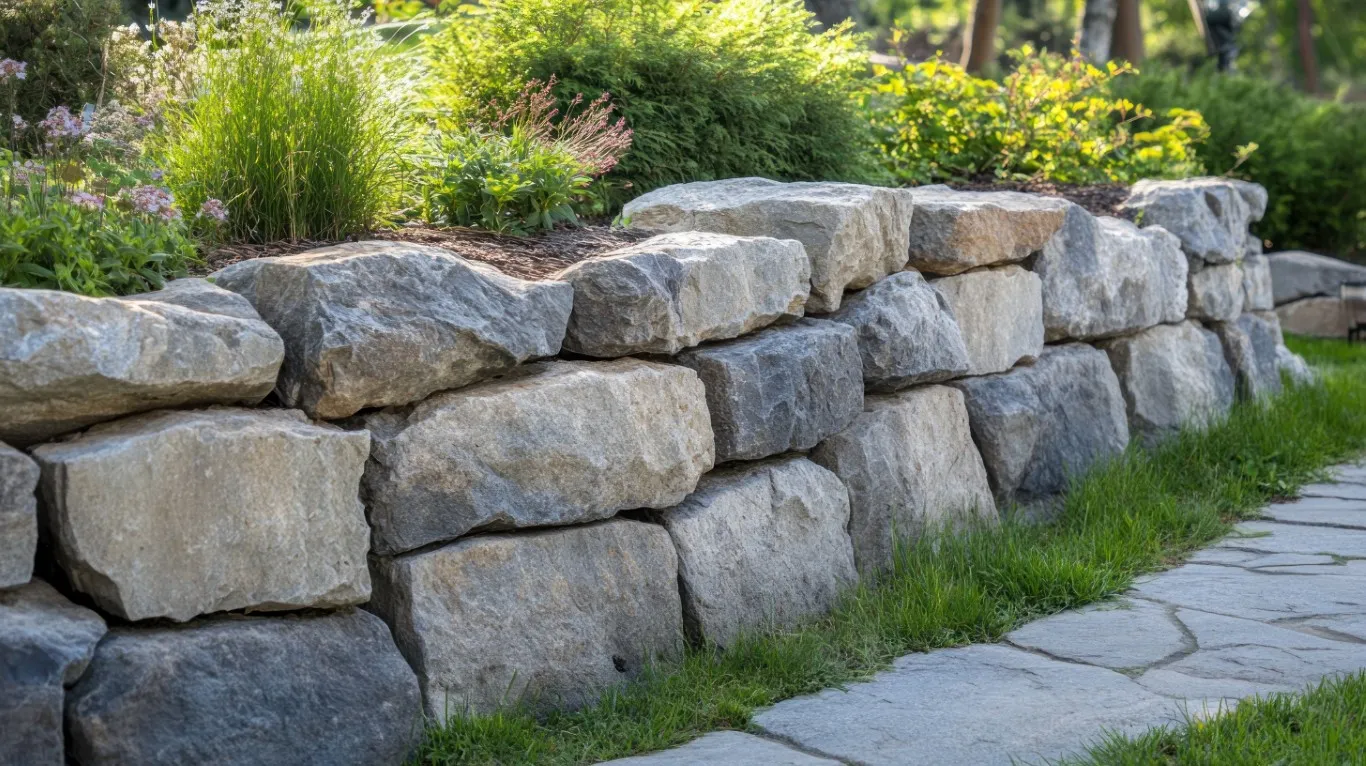
Quick answer: A natural stone retaining wall Utah County homeowners build, including fieldstone, boulders, and dry-stack, delivers an organic look and strong longevity, but it demands skilled labor and careful drainage to perform in our expansive clay soils.
Stone has an obvious advantage: it looks like it belongs in the Utah landscape, especially in foothill neighborhoods like Alpine and Highland where boulder walls blend into the natural terrain. A properly built boulder wall can hold a slope for decades with proper drainage and installation because the sheer mass of the stone resists lateral soil pressure.
The variety within natural stone matters for your decision:
- Boulder walls: large stones stacked with equipment, ideal for taller slopes and rugged aesthetics
- Dry-stack fieldstone: smaller flat stones fitted by hand for a refined, traditional look
- Mortared stone: stone veneer over a structural core when a formal finish is wanted
The catch is labor and gaps. Dry-stack walls rely on the mason’s skill to fit irregular stones tightly, and that craftsmanship takes time. Gaps between stones also mean you must engineer drainage carefully so clay soil behind the wall does not push through or wash out during wet-dry cycles.
When natural stone is installed with proper gravel backfill and drainage, it is one of the most durable and beautiful options in our climate. Boulder walls in particular have performed well across Utah County hillsides for erosion control.
Are Timber and Railroad Tie Retaining Walls a Good Idea in Utah?
Quick answer: A timber retaining wall Utah homeowners install can work for short, low-stakes grade changes, but its lifespan is limited because our wet-dry soil cycles accelerate rot, making it a shorter-term solution than block or stone.
Let’s be honest about wood. A timber wall goes up quickly and has a warm, rustic look that suits garden beds and low terraces. For a short wall retaining a planter or a gentle slope, it is a reasonable choice.
The challenge is longevity in Utah’s soil. Our clay holds moisture against the wood, then dries out, then saturates again during spring runoff. That constant wet-dry swing is exactly the condition that rots timber fastest, even pressure-treated lumber. What looks solid at installation can soften at the base within years where it contacts damp soil.
Older railroad ties are no longer recommended for residential walls. They were treated with creosote, and that concern about creosote leaching is the main reason many contractors have moved away from using them in home landscapes and garden areas. If you have inherited an aging tie wall, replacing it with block or stone is often the smarter long-term move.
The hidden cost of timber is the rebuild. A wood wall that needs replacing in a fraction of the time a block or stone wall lasts often costs more over the life of your yard than choosing a durable material once. For a wall you want to forget about for decades, wood is rarely the answer in our climate.
When Do You Need a Poured Concrete Retaining Wall in Utah?
Quick answer: A poured concrete retaining wall Utah homeowners choose becomes the right option for significant grade changes, tall walls, and situations demanding maximum structural strength, and in Utah County walls over 4 feet typically require an engineered design and a permit.
Poured concrete is the heavy-duty option. Reinforced with steel rebar and engineered to specification, these walls handle the largest loads and steepest slopes. When you are holding back a substantial hillside or building close to a foundation, poured concrete gives you strength no stacked system can match.
Utah County municipalities typically require a permit and engineered plans for retaining walls above 4 feet in exposed height, and that threshold can drop when a wall supports a surcharge like a driveway or is part of a tiered system. Codes change and vary by city, so confirm the current requirement with your local municipality before you break ground. A licensed contractor handles this process for you.
One insider tip: ask any contractor about expansion joints. Poured concrete expands and contracts through our 100-plus annual freeze-thaw cycles, and properly placed expansion joints are what prevent the random cracking you see in walls poured without them. It is a small detail that separates a wall that lasts from one that spiders with cracks in a few winters.
Poured concrete is not always the answer, though. It is the least forgiving material for DIY, and its flat gray face reads as utilitarian unless you veneer or texture it. For projects where poured concrete makes sense, our concrete installation services cover patios, walkways, and structural work built for Utah’s climate.
Ready to figure out which material fits your slope? Contact Utah Valley Landscaping at (801) 899-9199 to talk through your project and request an estimate.
How Do Retaining Wall Materials Compare on Durability, Cost, and Maintenance?
Quick answer: Segmental block and natural stone lead on durability and low maintenance in Utah, poured concrete leads on structural strength, and timber trails on longevity, so the right pick depends on your priorities across these four factors. Understanding retaining wall cost per material Utah conditions favor helps you plan realistically before you call a contractor.
Here is how the four materials stack up across the criteria Utah homeowners care about most.
Segmental concrete block:
- Durability: high, decades with proper drainage and installation
- Cost: mid-range relative to other options, contact for an estimate
- Maintenance: low, occasional inspection of drainage
- Best for: many residential slopes, curved walls, modern and traditional homes
Natural stone (boulder and dry-stack):
- Durability: high with proper drainage and installation
- Cost: varies with stone type and labor intensity, contact for an estimate
- Maintenance: low, occasional resetting of shifted stones
- Best for: foothill lots, organic aesthetics, erosion control on slopes
Timber:
- Durability: limited, shorter lifespan in Utah’s wet-dry clay soils
- Cost: lower upfront but higher over time due to replacement, contact for an estimate
- Maintenance: higher, monitor for rot at soil contact
- Best for: short garden terraces and low, non-structural beds
Poured concrete:
- Durability: very high when engineered with expansion joints
- Cost: higher, reflects engineering and reinforcement, contact for an estimate
- Maintenance: low, watch for cracks if joints were skipped
- Best for: tall walls, significant grade changes, maximum strength needs
Because material choice and total project cost go hand in hand, this comparison pairs well with our broader breakdown of what landscaping really costs in Utah Valley so you can move from picking a material to planning the full project.
Which Retaining Wall Material Is Right for Your Utah Yard?
Quick answer: Choose your retaining wall material based on wall height and slope severity first, then aesthetics and longevity: short garden walls have flexible options, mid-height walls favor segmental block or stone, and tall or structural walls call for engineered poured concrete. That is how you find the best retaining wall for Utah conditions and your specific yard.
Use this simple framework to narrow your choice before you call a contractor.
- Short walls under about 3 feet on gentle slopes: you have the most freedom. Segmental block, dry-stack stone, and even timber for non-structural planters are all in play. Let aesthetics and how long you want it to last guide you.
- Mid-height walls around 3 to 4 feet: lean toward segmental block or natural stone. Both flex with our clay soils, handle freeze-thaw well, and last for decades when drainage is done right. Boulder walls shine on foothill lots in Alpine and Highland.
- Tall walls over 4 feet or walls supporting a driveway: this is engineered territory. Expect a permit requirement in most Utah County cities and plan for poured concrete or a reinforced segmental system with geogrid. Do not attempt this as a DIY project. You can review general soil and construction guidance from the Utah Geological Survey and load-related standards from the American Society of Civil Engineers as you prepare.
- Steep or eroding slopes: prioritize mass and drainage over looks. Boulder walls and engineered systems control erosion best.
Whatever you choose, remember that a retaining wall is rarely the end goal. A good wall turns a sloped, unusable yard into flat space where your family gathers, plays, and creates memories. Across our own retaining wall projects in Utah County, including work in Alpine and Highland, the walls that hold up best are the ones where drainage and material were matched to the site from the start. If you are ready to plan the whole space, our landscape design and installation team helps Utah families turn tricky terrain into an outdoor living space they actually use.
The right retaining wall for Utah is the one matched to your slope, your soil, and the life you want in your backyard, not a cookie-cutter template. If you are weighing block against stone or wondering whether your grade change needs engineering, contact Utah Valley Landscaping at (801) 899-9199 or reach out through our contact page to discuss your project and request an estimate. Let’s build a yard where your family creates memories for years to come.
Frequently Asked Questions
What is the longest lasting retaining wall material in Utah?
Poured concrete offers the highest structural longevity when it is engineered with steel reinforcement and proper expansion joints, easily lasting decades in our freeze-thaw climate. Segmental concrete block and natural stone also perform for decades when installed with correct gravel backfill and drainage. The key across all three is drainage, since even the strongest material fails early when water is trapped against it. Timber is the clear exception and has the shortest lifespan of the common options.
How much does a natural stone retaining wall cost in Utah County?
The cost of a natural stone wall varies widely based on the type of stone, wall height, and how labor intensive the installation is. Dry-stack fieldstone requires skilled hand fitting, while boulder walls need heavy equipment, and both factors influence the final price. Drainage work behind the wall also adds to the total. For an accurate number tailored to your slope and stone choice, contact Utah Valley Landscaping at (801) 899-9199 for an estimate.
Do I need a permit for a retaining wall in Utah County?
Most Utah County municipalities require a permit and engineered plans for retaining walls above 4 feet in exposed height. That threshold can drop lower when a wall supports a surcharge like a driveway or forms part of a tiered system. Because codes change and vary by city, confirm the current requirement with your local municipality before you begin. A licensed contractor typically handles this permitting process on your behalf.
Can timber retaining walls handle Utah winters?
Timber walls can handle short, low-stakes grade changes, but Utah’s soil conditions limit their overall lifespan. The bigger issue is not the cold itself but the wet-dry swing in our clay soils, which holds moisture against the wood and accelerates rot even in pressure-treated lumber. This constant saturation and drying softens the base where the timber meets damp soil. For a wall you want to last decades, block or stone is a more reliable choice.
What retaining wall material is best for a steep slope in Utah?
For steep or eroding slopes, prioritize mass and drainage over aesthetics. Boulder walls perform well because the sheer weight of the stone resists lateral soil pressure and controls erosion. For taller structural applications, engineered poured concrete or a reinforced segmental system with geogrid handles the largest loads. Whatever the material, careful drainage design is essential on steep terrain where runoff is heavier.
How do freeze-thaw cycles affect retaining walls in Utah?
Utah County experiences roughly 100 to 130 freeze-thaw cycles per year, and each one causes water in the soil and wall base to expand as it freezes then contract as it thaws. This repeated push-and-pull cracks rigid materials and heaves foundations that were not built to move with it. Segmental block handles this well because its unmortared joints flex rather than fracture. Poured concrete relies on properly placed expansion joints to avoid random cracking through these cycles.
What is the cheapest retaining wall option that will still last in Utah?
Timber has the lowest upfront cost but rarely the best value, since it needs rebuilding in a fraction of the time durable materials last. For a wall that is affordable yet built to endure, segmental concrete block usually offers the strongest balance of mid-range cost and long-term durability. It flexes with clay soils, handles freeze-thaw well, and requires little maintenance beyond occasional drainage inspection. Choosing a lasting material once often costs less over the life of your yard than repeatedly replacing a cheaper one.